If you are wondering how to get freelance web development clients without living on job boards or racing other developers to the lowest price, the answer is less about luck and more about systems. Clients come from a handful of repeatable channels, and each one works better when you know exactly who you help and can prove it. This guide walks through the channels I recommend, the trade-offs of each, and a simple pipeline so nothing slips through the cracks.
Start with a niche and a clear position
“I build websites” is a sentence every prospect has heard a hundred times. “I build fast, bookable websites for physiotherapy clinics” gives a clinic owner a reason to keep reading. A niche doesn’t have to be forever, and it doesn’t stop you taking other work. It simply makes your marketing specific enough to land.
You can niche by any of these, or a combination:
- Industry: clinics, restaurants, SaaS startups, real estate, education.
- Platform: WordPress, Shopify, Webflow, Next.js.
- Problem: slow sites, broken checkouts, migrations, technical SEO.
- Client type: agencies needing overflow help, funded startups, local service businesses.
Write a one-line positioning statement and use it everywhere: your homepage, LinkedIn headline, email signature and proposals. A simple formula is “I help [who] get [outcome] with [what you do].” If you can’t fill in the “who”, that is the first thing to fix.
Build a portfolio with real case studies
A grid of screenshots shows that you can make things look nice. A case study shows that you can solve a business problem, which is what clients actually pay for. Even two or three solid case studies will do more work than twenty thumbnails.
Structure each case study the same way:
- Problem: what was wrong or missing, in the client’s terms (not “needed a React frontend” but “customers couldn’t book on mobile”).
- Approach: the decisions you made and why: stack, structure, trade-offs, what you chose not to do.
- Result: what changed. Use real, measured outcomes if you have permission to share them; otherwise describe the qualitative change honestly.
If you are early in your career, build one or two projects for a realistic imaginary client, or rebuild an existing site you think could be better, and label it clearly as a concept. Honesty here matters more than polish. You can see how I structure mine on my portfolio.
Referrals and repeat clients: your cheapest channel
The easiest client to win is one who already trusts you. Past clients and the people they know are usually the warmest source of work you have, yet many freelancers never ask.
- Ask at the right moment. The best time is right after a successful launch, when the client is happiest. A simple “If you know anyone who needs similar help, I’d be grateful for an introduction” is enough.
- Make it easy. Give them a one-line description of who you help, so they can forward it without thinking.
- Stay in touch. A short check-in every few months (“Noticed your new product launch, congratulations, how is the site holding up?”) keeps you top of mind without being salesy.
- Offer ongoing care. A maintenance or support plan turns one-off projects into a relationship and naturally leads to the next piece of work.
Local businesses and agency partnerships
Local businesses
Many local businesses have websites that are slow, hard to update, or missing basics like online booking. They often prefer someone they can meet or call directly. Try local business associations, co-working spaces and community events, and lead with a specific observation (“your menu is a PDF that’s hard to read on phones”) rather than a generic pitch.
Partnering with agencies
Design studios, marketing agencies and SEO consultancies often need dependable developers for overflow or specialist work. It is usually white-label, but it can provide steady volume. Be reliable above all, agree rates, revision limits and client contact upfront, and avoid depending on a single agency for most of your income.
Content, SEO and LinkedIn
Content is the slowest channel to start and the one that keeps working while you sleep. Practical articles about the problems your niche faces build trust and bring inbound enquiries over time. If you build WordPress sites, for example, a guide like a Core Web Vitals checklist for WordPress attracts exactly the people who need that work done. Write for buyers rather than other developers, and repurpose each article into a few LinkedIn posts.
On LinkedIn, treat your profile as a landing page: a clear headline with your positioning, a featured section with case studies, and a way to contact you. Post consistently about real work and lessons learned, and comment thoughtfully on posts by people in your target market. Connection requests with a short, genuine note tend to land better than blank ones followed by an immediate pitch.
Marketplaces like Upwork: the trade-offs
Marketplaces such as Upwork, Fiverr, Toptal and Contra can be a useful way to get your first clients and reviews, but they come with real trade-offs.
| Pros | Cons |
|---|---|
| Buyers are already looking to hire | Heavy competition, often on price |
| Built-in payment protection and contracts | Platform fees reduce what you take home |
| Reviews build credibility quickly | You don’t own the client relationship or audience |
| Good for learning to scope and pitch | Algorithm changes can affect your visibility |
If you use marketplaces, be selective. Apply to fewer, better-fit jobs with tailored proposals, filter for clients with verified payment and a reasonable history, and aim to use the platform as a stepping stone rather than your whole business. Always follow each platform’s terms on taking work off-platform.
Cold outreach done respectfully
Cold outreach gets a bad name because most of it is lazy: mass templates, fake compliments and pushy follow-ups. Done well, it is simply introducing yourself to a business you can genuinely help.
The principles are straightforward:
- Target narrowly. A short list of well-researched prospects beats a large list of random ones.
- Lead with a real observation about their site or business, not a generic compliment.
- Keep it short with one clear, low-pressure ask.
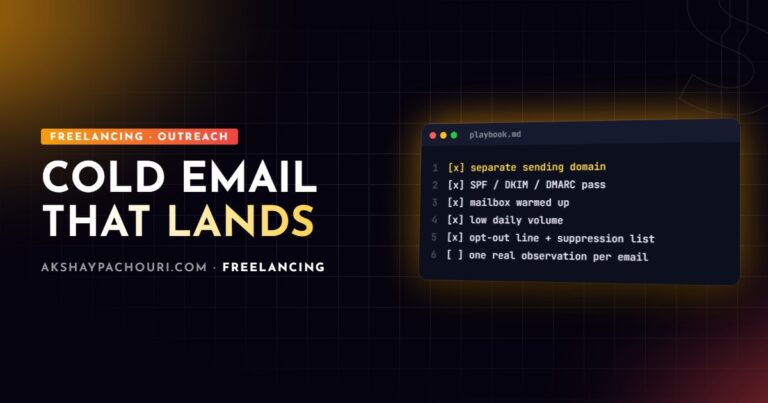
- Respect the inbox. Send from a properly set-up domain, keep volume low, include a way to opt out, and stop when someone says no.
There is more to it, especially on deliverability and legal basics, and I cover it in detail in cold email for freelance developers.
Follow-up cadence: where most deals are won
Plenty of prospects are interested but busy. A polite follow-up is a service, not a nuisance, as long as it adds something and stops at a sensible point. A cadence I’d suggest as a starting point:
- Day 0: initial message or proposal.
- Around day 3–4: a short nudge, perhaps with one useful extra detail.
- Around day 7–10: share something relevant: a related case study, a quick tip, or an answer to a likely objection.
- Around day 14–21: a polite close-the-loop message (“I’ll assume the timing isn’t right, happy to reconnect later”).
After that, move them to a “nurture” list and check in occasionally. Adjust timings to the relationship; a warm referral deserves a faster, more personal follow-up than a cold contact.
Track a simple pipeline
You don’t need a CRM to start. A spreadsheet or a simple board is enough, as long as you update it. What matters is knowing who you’ve contacted, what stage they’re at, and what the next action is.
Lead        | Source    | Stage         | Next action          | Due
------------|-----------|---------------|----------------------|--------
Clinic A    | Referral  | Discovery call| Send proposal        | Mon
Cafe B      | Local     | Contacted     | Follow-up #2         | Wed
Agency C    | LinkedIn  | Proposal sent | Check in             | Fri
Startup D   | Content   | Won           | Kick-off & deposit   | Today
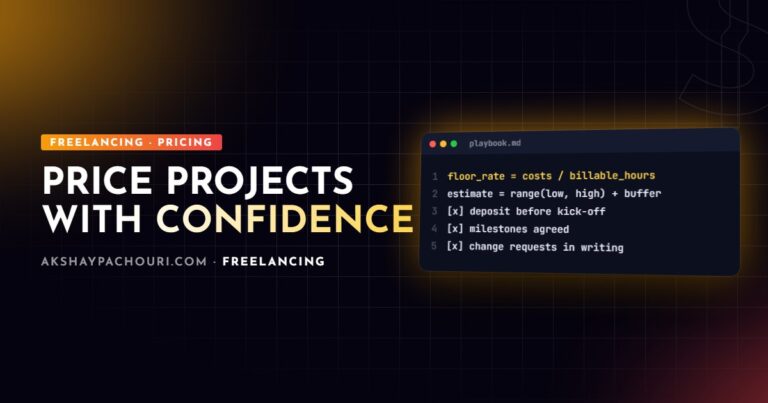
Useful stages are: Researched → Contacted → Replied → Call booked → Proposal sent → Won / Lost / Nurture. Once a month, look at which sources produce replies, calls and paid work, then put more time into those and less into the rest. Once leads arrive, pricing and proposals become the next bottleneck; see how to price freelance web development projects.
Key takeaways
- Pick a niche and a one-line positioning statement before anything else.
- Replace screenshot galleries with a few problem → approach → result case studies.
- Ask happy clients for referrals and offer ongoing care to create repeat work.
- Local businesses and agencies are underrated, relationship-driven channels.
- Content and LinkedIn are slow but compound; marketplaces are fast but costly in competition and fees.
- Cold outreach works when it is targeted, specific, short and respectful.
- Follow up with purpose, and track every lead in a simple pipeline.
Frequently asked questions
What is the fastest way to get your first freelance web development client?
Start with your existing network and local businesses, where trust is easier to build, and offer a clearly scoped project with a defined outcome. Marketplaces can also help you land early work and reviews, though competition there is heavy.
Do I need a niche to get freelance clients?
You don’t strictly need one, but a niche makes your marketing far more specific and easier to act on. You can still accept work outside it; the niche mainly shapes how you present yourself.
Is Upwork worth it for web developers?
It can be worth it for early clients, reviews and practice with scoping, as long as you apply selectively and price sensibly. Treat it as one channel among several rather than your entire business, because you don’t own the client relationship there.
How many times should I follow up with a prospect?
Three or four thoughtful follow-ups spread over two to three weeks is a reasonable starting point, each adding something useful. Stop immediately if someone asks you to, and move quiet leads to an occasional check-in list.
If you are a business owner looking for a developer who builds fast, well-structured websites and actually cares about the results, I’d be glad to help. Get in touch with a short note about your project and I’ll reply with next steps.