Scope creep rarely arrives as one big demand. It shows up as a dozen small “while you’re in there” requests that together turn a profitable project into an unpaid one. This guide covers how to handle scope creep: spotting it early, writing scope documents that hold up, running a change-request process with ready-to-use templates, pricing changes and saying no without damaging the relationship.
What scope creep is, and why it happens
Scope creep is any growth in the work beyond what was agreed, without a matching change to budget or timeline. It’s rarely malicious. Clients learn what they want as they see the project take shape, stakeholders who weren’t involved early start giving feedback, and a vague brief leaves room for different interpretations.
Developers contribute too. Saying “sure, that’s quick” to keep a client happy feels generous, but each yes resets expectations about what’s included. Not every change is creep, though. Changes are normal and often make the product better. The problem is unmanaged change: work that isn’t acknowledged, estimated or paid for.
Spotting scope creep early
The earlier you notice it, the easier the conversation. Watch for these signals:
- Phrases like “small tweak”, “quick addition”, “while you’re at it” or “I assumed this was included”.
- New stakeholders appearing mid-project with their own requirements.
- Feedback rounds that introduce new features instead of refining agreed ones.
- Requests that touch a different part of the system, such as adding a membership area to a brochure site.
- “Can it also…” messages arriving outside your normal communication channel, like a WhatsApp message on a Sunday.
- Your own time tracking drifting above the estimate for a phase that should be stable.
Make a habit of comparing every request against the scope document before replying. That single pause is the most effective defence you have.
Write a scope document that prevents arguments
You can’t manage changes to a scope that was never defined. A good scope document is specific enough that a third party could read it and tell whether a request is in or out. It’s also the backbone of a winning pitch; my guide to writing a freelance proposal that wins clients covers how to present it.
Include these sections:
- Goals: what the project should achieve, in one or two sentences.
- Deliverables: each page, template, feature and integration, listed individually with a short description.
- Assumptions: the client provides final copy and images by a date; the design is based on an existing brand; a named payment gateway is used.
- Revisions: how many rounds are included at design and development stages.
- Out of scope: an explicit list, such as content writing, logo design, data migration beyond a stated number of records, multilingual support, ongoing maintenance.
- Change process: a reference to how changes are requested and approved.
The out-of-scope list feels awkward to write, but it’s often the most valuable part. It turns a future argument into a simple reference: “That’s listed under out of scope in section 5; happy to quote it separately.”
Make the scope part of your signed agreement. My guide to freelance web developer contract essentials explains how the scope, change-request and payment clauses fit together.
Set up a change-request process
A change-request process turns “can you also…” from a negotiation into a routine. Keep it light enough that clients will actually use it:
- Acknowledge the request quickly and positively.
- Classify it: is it a bug against the agreed scope (fix it), a clarification (note it), or new work (estimate it)?
- Estimate the cost and the effect on the timeline.
- Get written approval before starting. Email is fine if your contract says so.
- Log it in a change log so both sides can see the history and the running total.
Batching helps too. Instead of quoting every tiny request separately, collect them over a week and send one change order. Clients appreciate fewer interruptions, and you avoid the overhead of quoting a ten-minute task.
Template: acknowledging a request
Hi [Name], thanks for this, adding [feature] makes sense. It isn’t part of the current scope, so I’ll put together a quick estimate of the time and cost and send it over by [day]. In the meantime I’ll keep working on [current milestone] so we stay on schedule.
Template: change order
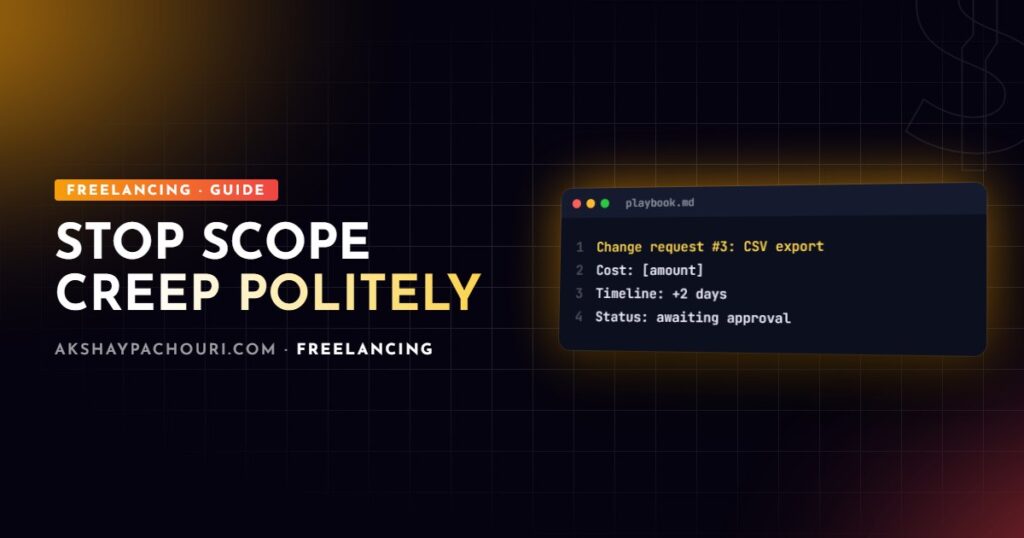
Change request #[number]: [short title]
- Requested by: [Name], [date]
- Description: [What will be built, in one or two sentences]
- Reason it’s outside the original scope: [Reference to scope section]
- Estimated effort: [hours or fixed price]
- Cost: [amount]
- Timeline impact: [e.g. launch moves from X to Y, or no change]
Approval: Please reply “Approved” to this email to go ahead. Work starts after approval and will be invoiced with the next milestone.
Template: a simple change log
| # | Request | Date | Estimate | Status |
|---|---|---|---|---|
| 1 | Add testimonials slider to home page | [date] | [cost] | Approved |
| 2 | Export orders to CSV | [date] | [cost] | Awaiting approval |
| 3 | Change heading font | [date] | Included (revision round 2) | Done |
A shared spreadsheet or a project board is plenty. What matters is that both sides can see it.
Pricing changes fairly
How you price changes depends on how you priced the project. With hourly billing, approved changes are simply more hours, though an estimate still helps the client decide. With fixed-price projects, quote each change as its own fixed price or a capped estimate.
A few principles keep pricing fair and defensible:
- Include the hidden work. A new feature also needs testing, responsive checks, content entry and sometimes changes to existing code. Estimate the whole thing, not just the visible part.
- Price the timeline impact. If a change pushes launch back or requires rearranging your other commitments, say so in the quote.
- Offer options. “Option A does the full feature; option B is a simpler version that fits the current budget.” Clients feel in control, and you often find a sensible middle ground.
- Trade, don’t just add. If the budget is fixed, offer to swap the new item for something of similar size that hasn’t started yet.
Use the same rates and reasoning you used for the original quote, so change pricing never looks improvised.
Saying no gracefully
Sometimes the answer has to be “not now” or “not in this project”. The aim is to decline the request without rejecting the person. Lead with what you can do, and give a reason tied to their interests, such as the launch date or quality.
“I’d love to build the member dashboard, and I think it’s a strong idea. Adding it now would push the launch past [date], which you mentioned matters for the campaign. How about we launch on schedule and make the dashboard phase two? I can send a separate estimate this week.”
Other useful phrasings:
- “That’s outside what we agreed, but I can quote it as an add-on.”
- “We can include that if we drop [item] from this phase. Which matters more to you?”
- “I’d recommend against it for now because [technical reason]. Here’s what I’d suggest instead.”
Avoid apologising for having a process, and avoid vague delays like “I’ll see what I can do”. Clear, friendly answers build more trust than reluctant yeses.
Keeping the relationship strong
Handled well, managing scope makes clients trust you more. They know what they’re paying for, they’re never surprised by an invoice, and they see you protecting their deadline.
- Explain the process at kickoff, before any change comes up, so it never feels like a reaction to one request.
- Give small things away deliberately. If you choose to include a minor extra, say so: “This one’s on me; it’s outside scope, but small.” The goodwill is noticed and expectations stay intact.
- Send regular status updates showing progress against scope and the change log.
- Keep a “phase two” list. Parked ideas become your next project together rather than lost requests.
If a client repeatedly ignores the process despite all this, that’s a different problem; my guide to managing difficult clients covers when and how to escalate.
Key takeaways
- Scope creep is unmanaged change, not change itself.
- Write a scope document with explicit deliverables, assumptions, revision limits and an out-of-scope list.
- Run every new request through acknowledge, classify, estimate, approve and log.
- Price the whole change, including testing and timeline impact, and offer options or trades.
- Say no by offering a path forward, such as a phase two or a swap.
- Explain the process at kickoff so it feels routine, not personal.
Frequently asked questions
How do I tell a client a request is out of scope without upsetting them?
Acknowledge that the idea is good, point to the agreed scope document, and offer a quote or a phase-two plan in the same message. Framing it as protecting their budget and launch date keeps the tone collaborative.
Should I charge for every small change?
Not necessarily. You can include small extras deliberately as goodwill, but say they are outside scope so expectations do not shift, and batch other minor requests into one change order.
What should a change request include?
A short description of the work, why it is outside the original scope, the cost, the timeline impact and a clear way to approve it in writing. Keep a log of every request and its status.
How can I prevent scope creep before a project starts?
Agree on a detailed scope with an explicit out-of-scope list, define the number of revision rounds, and explain your change-request process at kickoff. Make the scope part of the signed contract.
Want a developer who keeps projects on scope, on budget and transparent from start to finish? Let’s talk about what you need built.